SEO in the AI Era: A Practical Guide to Generative Engine Optimization (GEO)
Where do you go first when you want to know something? A few years ago there was only one answer: Google. Today, it's increasingly ChatGPT, Perplexity, Gemini, or Google's own AI Overviews box. Users no longer click through ten blue links and assemble the answer themselves — they get the answer pre-assembled.
That changes the rules for everyone who publishes content. The old goal was "rank on page one of Google." Now there's a second goal stacked on top: be the source the AI cites inside its answer. That practice has a name — GEO, Generative Engine Optimization.
In this post I'll cover what GEO is, how it differs from classic SEO, and the exact tactics I applied while building this very site.
Let me state the most important truth upfront: SEO and GEO are not alternatives — they are two channels that feed each other. I know this from practice, not theory: on orhunercan.com, a site I manage, I watch it happen day after day — as Google rankings strengthen, the site gets cited in AI answers more often. Later in this post I'll tell the full story with that site's Search Console chart — including the drop caused by a Google update and the Dan Brown-powered recovery.
What Is GEO?
Generative Engine Optimization (GEO) is the practice of making your content discoverable, understandable, and citable by generative AI engines — ChatGPT, Perplexity, Gemini, Claude, and AI Overviews — when they compose answers.
The term was coined in 2023 in an academic paper by researchers from Princeton, Georgia Tech, and IIT Delhi. Its most striking finding: simple interventions like adding statistics, quotations, and citations to content can increase that content's visibility in AI answers by up to 40%.
The simplest way to frame the difference:
- SEO: "Get Google to list me, get the user to click me."
- GEO: "Get the AI to read me, get it to cite me inside its answer."
How AI Search Engines Use Your Content
Before the tactics, it's worth understanding the mechanism — because every tactic derives from it.
Most AI search tools work with RAG (Retrieval-Augmented Generation). In plain terms: the model doesn't make the answer up from memory; it first fetches relevant web pages live (retrieval), then synthesizes the answer from them (generation), usually linking to the sources it used.
This process has three critical consequences for you:
- Bots must be able to reach your site. For the AI to fetch your page at answer time, you must not block answer-mode bots.
- Content must be quotable. The AI picks clear, self-contained passages it can drop into an answer with minimal processing.
- Trust signals are weighed. Who wrote it, when, does it carry data, do other sources corroborate it — all of it affects your odds of being selected.
Is SEO Dead? No — But the Ground Shifted
Let's correct a common misconception: GEO doesn't replace SEO. GEO is built on top of SEO.
| Classic SEO | GEO | |
|---|---|---|
| Goal | Top of the SERP | Citation inside the AI answer |
| Unit | The page | The paragraph / passage |
| Clicks | The goal itself | Often zero-click visibility |
| Signals | Backlinks, keywords | Clarity, data, authority, structured data |
| Measurement | Rankings, organic traffic | Mention rate in AI answers, AI referrer traffic |
The critical point: AI engines' retrieval layers feed heavily on classic search indexes. A page invisible on Google has slim odds of making it into a Perplexity answer. In other words, if your technical SEO is broken, it's too early to talk GEO. Foundations first: fast site, clean indexing, sitemap, sane information architecture.
GEO in Practice: What We Did on This Site
Everyone writes the theory. Let me show you the GEO layer I implemented while preparing this site (growthmadre.com) for launch — with the code and the reasoning.
1. Manage AI bots deliberately in robots.txt
Not all AI bots are equal. There are two distinct kinds, and applying one rule to both is a mistake:
- Answer-mode bots (ChatGPT-User, OAI-SearchBot, PerplexityBot, Claude-User): they fetch your page the moment a user asks a question and cite you as a source. Blocking them means opting out of AI answer visibility.
- Training-only crawlers (GPTBot, CCBot, Bytespider): they harvest your content for model training. No citation, no traffic.
Our policy: allow answer-mode bots, block training-only crawlers. Capture the visibility upside, limit the uncompensated data giveaway.
# Answer-mode bots → allowed (citations + traffic)
User-agent: PerplexityBot
User-agent: OAI-SearchBot
User-agent: Claude-User
Allow: /

# Training-only crawlers → blocked
User-agent: GPTBot
User-agent: CCBot
Disallow: /
2. Add an llms.txt
llms.txt is an emerging standard: a file at your site root that tells AI systems what the site is, what it contains, and how to cite it. Not every engine reads it yet, but it costs five minutes and early movers win. You can see ours at growthmadre.com/llms.txt — site description, key URLs, topics, and citation guidance.
3. Structured data (JSON-LD) — speaking machine
AI systems and search engines use structured data to understand your pages. Every blog post on this site ships with these schemas:
- BlogPosting — headline, author, date, language, keywords
- BreadcrumbList — the page's place in the site hierarchy
- Organization + WebSite — the site's identity and publisher
Invisible to readers, but on the machine side it answers "who wrote this, when, and about what" with certainty. Everything that reduces ambiguity increases your odds of being selected.
4. Write quotable paragraphs
When an AI synthesizes an answer, it prefers clear passages that stay meaningful when lifted out of context. Practical rules:
- Make each section readable on its own. A paragraph that opens with "as I mentioned above" turns meaningless when quoted.
- Write definitions explicitly. Sentences in the "X is ..." pattern are gold for AI — the first sentence of this post's "What Is GEO?" section follows exactly that pattern.
- Use question-answer structure. Phrase headings the way users actually ask ("Is SEO Dead?").
- Include numbers and data. Remember the Princeton finding: adding statistics boosts visibility by up to 40%. AIs love passages they can cite as "according to research, X%."
5. Publish real experience (E-E-A-T)
The first E in Google's quality framework — Experience — is worth even more in the AI era, because it's the one thing AI cannot generate itself. Every model already knows the generic knowledge; your data, case studies, failed experiments, and screenshots are unique.
Let's not leave that as theory — here's a story from my own work.
Case study: a Google update, a falling chart, and Dan Brown
On orhunercan.com, a site I built for a psychiatrist, I published around 50 blog posts. The effect of the first comprehensive SEO push became visible on April 23: impressions started climbing fast.
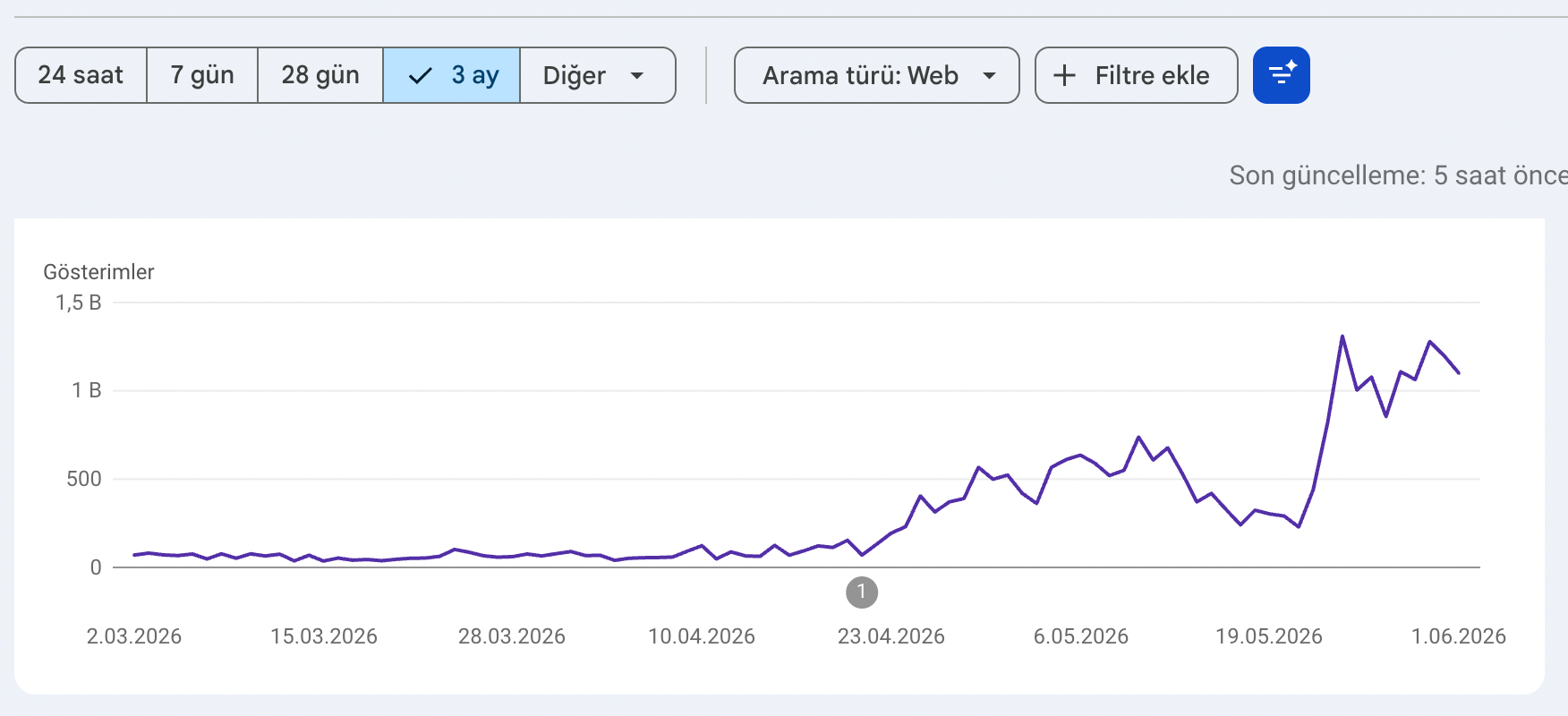
orhunercan.com's 3-month Search Console impressions chart: first SEO impact (April 23), the drop after a Google update (mid-May), and the post-recovery peak.
Then, in mid-May, Google shipped an update targeting low-quality AI-generated content. You can see it on the chart: impressions went into decline. I had 50 posts produced with AI assistance, and Google was now recognizing that pattern and ranking it down.
My fix: I fed Dan Brown's writing to an AI and had it analyze his sentence rhythm, paragraph construction, and narrative technique — then distilled the analysis into a writing style skill file. From that point on, every post was produced through that style guide. Why Dan Brown? His books reach some of the widest audiences in the world, and their pull is proven. There's a personal reason too: during my military service I read stacks of Dan Brown novels to unwind — I know firsthand how that prose drags you in.
The result: my posts stopped reading like "AI content" and started reading like a novelist's prose — and impressions recovered fast, hitting the new peak you see on the chart, nearly double the previous one.
To be honest: that recovery wasn't the skill file alone — there was a deep, multi-layered SEO effort behind it. But the move that separated me from competitors was that file. The lesson is clear: you can produce content with AI — but content that doesn't read like a human no longer survives.
6. If you publish in multiple languages, get hreflang right
This site publishes everything in Turkish and English. The GEO payoff: when someone asks Perplexity a question in English, your English page can be cited; ask in Turkish, your Turkish page can — visibility in two separate markets. The technical requirement is linking each page to its counterpart with hreflang tags and declaring the pairing in your sitemap. Done wrong, engines read your two languages as two separate (and mutually diluting) sites.
How to Measure Your AI Visibility
You can't manage what you don't measure. Three practical methods today:
- Referrer tracking: In your analytics, segment sessions from
chatgpt.com,perplexity.ai, andgemini.google.com. Absolute numbers may be small — the growth curve is the real signal. - Manual query testing: Each month, ask ChatGPT and Perplexity the same 10–15 questions in your target topics; track in a spreadsheet whether your brand/site gets mentioned. Primitive, but it works.
- Log analysis: If your server logs show
PerplexityBotorChatGPT-User, your content is being used in answers — and the logs tell you exactly which pages.
Summary: The GEO Checklist
The whole post, reduced to one list:
- Technical SEO foundation is solid (speed, indexing, sitemap)
- Answer-mode AI bots are allowed in robots.txt
- Your
llms.txtis live - Correct JSON-LD schemas on every page
- Definitions are explicit; sections are self-contained
- Content carries real data, statistics, and sources
- You publish your own experience, not generic knowledge
- Multilingual hreflang pairings are correct
- AI-driven traffic is measured as its own segment
Search behavior shifts once a decade — and we're in the middle of one of those shifts right now. The good news: those who sit down at the table while the game is new are already inside when the rules settle.
This post kicks off the hands-on GEO series I'll be publishing on GrowthMadre. In upcoming posts I'll share this site's AI visibility data openly — what worked, what didn't, with the numbers.
Share this post
Let AI Manage Your Google Ads
AI-assisted Google Ads campaign management over Slack with Hektera Ads. Optimize your performance.
Explore Hektera AdsRelated Posts
How a Dan Brown Style File Beat Google's AI Content Update
How I recovered traffic lost to Google's AI content update using a writing style skill file built from Dan Brown's prose — analysis, file structure, pipeline.
Who Audits the Verdict the Machine Produced?
My own Google Ads engine compared a bid step against the wrong window. Google's auto-apply rewrote a target CPA before dawn. Both had a rationale. Neither had evidence.
Google Keeps Closing the Manual Levers. What's Left of the Agency's Job?
Language targeting is going away too. As the control levers close, what actually gains value? Four real cases: measurement accuracy, causal discipline, and keeping ads aligned with business reality.
I can do this for your account too
I consult on Google Ads, measurement setup and conversion-focused websites. Let's start with a short intro call.
Write for consultingWeekly Newsletter
New analyses, experiments and case notes, straight to your inbox.